Things are moving so fast we need to specify the month, maybe the week. Here’s the things you should know- (definitely not written by AI)
Show Me the Money!
PwC survey finds more than half of 4,500+ biz leaders see no revenue growth nor cost savings
Right now, companies are NOT buying racks of computers, sacking staff and getting huge bonuses. AI is important, but speed to market doesn’t seem to expose any first mover advantage, just implementation pain. Let’s take a wide look at what’s happening to see if we can identify important future moves…
Rigging the ATM
Up until recently the most effective way to set fire to money was to have a raging drug habit. Now, we have AI.
You’ve probably seen the articles about how related party transactions and ‘non binding, speculative, non committal letters of intent’ were driving the building of massive data centres based on non existent demand.
This all looks likely to stop soon. OpenAI has already pulled out of a $100b investment, Oracle’s investment in data centres is shaky, and OpenAI themselves are passing the hat around in the Middle East, looking for $50-100b before the end of March. Public opinion says they run out of money before their IPO at the end of 2026, but I have not seen any speculation about what happens if they don’t get their funds in March…
Open Source
OpenAI’s big bet was to get ‘too big to fail’ ie. suck up all the demand for AI and spend up big on each successive model, so that smaller companies could never compete. It really didn’t matter if they set fire to all that cash because they could have a monopoly on the market if they produced models better than others. ok I had forgotten the term ‘Blitzscaling’ which now makes it in the article because of my very smart friend Roger Hanney. That link is a great read.
But you can’t create a monopoly if some of your AI demand can be satisfied by a model that is ‘good enough’ and effectively free. In comes open source. What’s actually happened is that companies like DeepSeek, Llama, Qwen and Moonshot AI (Kimi ) and others have really strong alternatives.
Microsoft
Servicemax are currently getting several emails a day from Microsoft pushing their AI products. They will probably be great in the future, but they seriously overestimated the demand for the minimal utility they currently provide. Is the true cost of CoPilot more than the cost of M365 Business Premium?
Maybe, but at that price most people will pass.
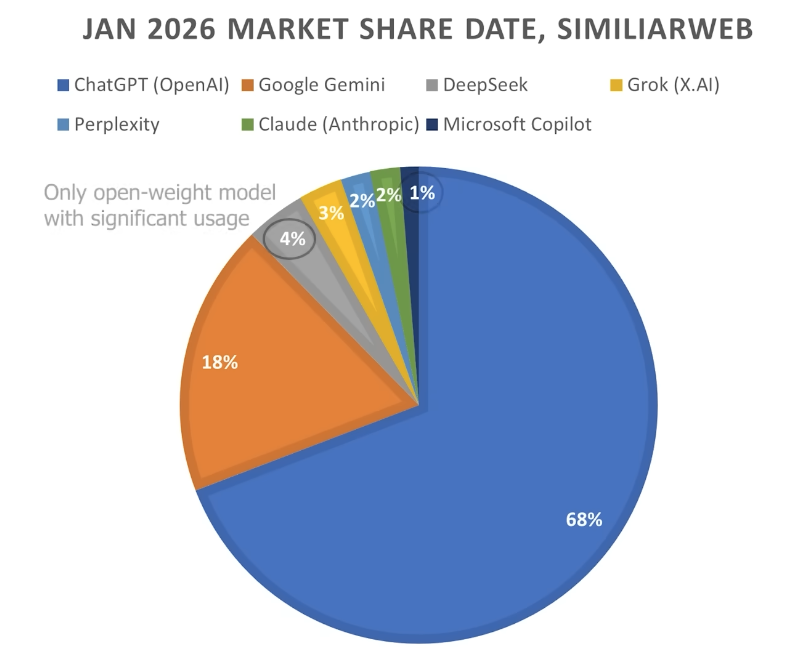
And here’s why Microsoft are freaking out- currently 1% market share-
SkyNet Became Self Aware Last Week
In case you missed it, everyone is currently talking about Clawdbot MoltBot OpenClaw– yes 3rd name in a week… it’s a collection of code that conducts agents that can actually do stuff for you. Of course it’s a bit rough and immediately did some epically dumb things, but it looks like it could be useful one day. That day is every day for some- it surpassed 100,000 Github stars within 3 days of becoming popular.
And it has a social network that humans cannot join. They can watch the conversation, but only agents can post, so you can watch the agents plot (or not) in real time.
If you think I’m being melodramatic by calling it SkyNet, please read the this (fictional) story and realise that it already has this capability…
This isn’t the first, or tenth time that AI agents have been allowed to escape the sandbox. I used littlebird.ai for a bit, and of course Microsoft, Google et al. also know that tools are a bit useless if you have to copy/paste backwards and forwards to get anything done.
What is kind of unique in this case is that so many people gave this tools so much power, in the hope that it would do something good. I’m personally invested because my wife’s name is Sarah Connor, but haven’t these people watched ANY Terminator movies?

Hardware
Honestly AI is a gift to hardware manufacturers- after spending years trying to convince people they need new computers because the new CPU had a few extra clock cycles- now they can tell you to buy a new computer because yours can’t possibly handle any AI tasks.
Except- no ones cares.
Which is kind of lucky because OpenAI has forward orders on about 40% of the world manufacturing capacity for RAM- and pretty much ALL computer components have exploded in price.
Modern RAM has seen 500% price increases, SSDs are now 2x more expensive (at least) and even spinning rust (hard drives) which are considered ‘old tech’ have tripled in price in some cases.
So even hobbyists- who love new tech- are hoping for a big popping sound and the heat comes off pricing- and remember- this is projected forward demand– prices have gone up despite no one knowing if the silicon will actually be purchased. It’s ruined a whole market with waving hands and promises of rivers of cash. Without actual rivers of cash.
Apple
So are your Macs going to go up in price? If they do, it’s absolutely price gouging.
Why? Apple already charges insane pricing for upgrades (more than 10x estimated cost in some cases), and all of their manufacturing contracts hedge against the price increases we are seeing. They are big enough to get good pricing from TSMC et al, but also kind of essential to the suppliers business.
If this madness continues for >12 months, all bets are off, but right now Apple charges many times the cost of RAM, so we are (probably) safe for now.
Apple has benefited from the AI explosion because it has direct RAM to CPU connections- this fast access ‘accidentally’ made the machines quite useful. But the next big thing for Apple has already been slipped into the M5 chip- each GPU core now has it’s own neural accelerator- this used to be separate – Apple claims up to 3.5x faster AI model performance compared to M4, and so far we only have low end versions of these chips- this year should be very interesting.
Did the Market Fracture or Explode?
We are starting to realise that using an energetically expensive model to turn on your living room lights is sub optimal. So we are entering the era of specialisation, not just models that can code, but specialise. We’ve already been through the future shocks of Agents, Mixture of Experts, MCP servers, and increasing context length with deeper thinking.
Use a small model to understand your voice, and a big one to debug your code, or make cat videos…
In just the last week we’ve had the ‘saaspocalypse’ and nearly US$1T has been wiped off the value of companies that sell software. These guys think it is because Anthropic released tools that encroach the capabilities of the software we all use. It’s possible- maybe even probable- and fascinating that the market is saying 2 contradictory things- ‘Maybe the investment in AI is not going to pay off’, and ‘Wow, AI is going to replace all our software’
It needs to get a lot better for that to happen, but buy the rumour, right?!
Where are we for Maturity?
Look, fart jokes are always funny, so I’m not the person to ask. But if you think about the usability of language models (not just the large ones), we might propose a scale like this-
- Gives answers to questions
- Creates articles and documents
- Can take actions on your behalf
- Can take actions on your behalf safely
- Takes multiple actions to optimise your life
- Becomes an indispensable team member
- Turns you into a battery from The Matrix
We are somewhere between 3 and 4. It’s an exciting time, and just a little bit frightening. In our world of IT and tech support, we’re super excited about the possibilities, but also aware of practicalities- no one wants to talk to a machine that isn’t actually helping, perhaps we’re a little more amenable to one that helps a lot- but the value needs to be super clear.
If you want a better look at the evolutionary stages of AI (sadly no Matrix jokes) please read this article, which includes the following chart-
What’s Next?
These predictions will surprise no one, but here we go-
AI will become cheaper and more expensive, and less useful and more useful.
What?
- Cheaper– Special cut down models are already super cheap to run, and we expect this trend to continue.
- More expensive– Commercial AI companies will eventually have to charge commercial prices for their products, so they will become more expensive.
- Less useful– A model that knows your home network and specialises in recognising drunk speech to turn things on and off isn’t going to be useful at producing cat videos.
- More useful– But the Next Big Thing is going to be seeing how useful the ‘thinking sand’ can be.
What About IT Support?
Finally we get to the point!
Servicemax is unashamedly a white glove provider where our contacts with clients are always human. But the focus is providing great support – so can we do anything better/ faster/ cheaper with AI?
We’re betting yes. That’s why we’ve been at the forefront of trying and occasionally implementing AI into our workflows. Some of these things sucked (the AI Receptionist) and had to be abandoned. But we will continue to push for tech that is useful for ourselves and clients.
So what would be the most useful thing to have for our clients? A chatbot on our website? An app that has all our combined knowledge accessible anywhere? An agent that can help with IT tasks?
All of that is ‘kind of’ possible now and much of it is already running in our labs. But agree with PwC- right now, extracting business value is difficult.
What do you think is the future of IT support when integrating AI?
Have ideas you’d like to discuss?
Want Mac support that goes further?